

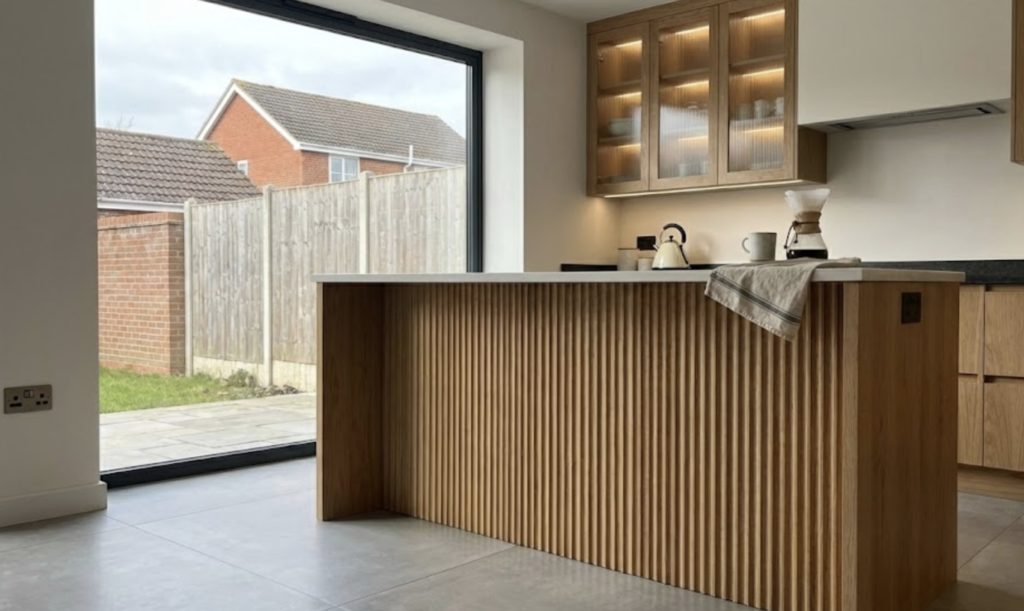
For the best part of a decade, the British kitchen landscape was dominated by one look: the “gloss slab.” You know the one. Handleless doors, mirror-like surfaces, and a colour palette that rarely strayed from clinical white, dove grey, or charcoal. It was sleek, it was modern, and—let’s be honest—it was often a little cold.
But as we move further into the mid-2020s, a fundamental shift is happening in interior design. We have collectively fallen out of love with the “showroom pristine” look that feels like an operating theatre. Instead, we are craving warmth, character, and depth.
The buzzword driving this change is texture.
A kitchen is no longer just about colour; it is about how the room feels—quite literally. It’s about running your hand along an island and feeling the rhythm of the wood. It’s about the way light catches the ridges of a cabinet door.
At the forefront of this textural revolution are two specific joinery trends: fluted detailing and celebrated natural grain. At BH Bespoak, we are seeing these requests in almost every consultation. Here is why texture is the new luxury, and how you can incorporate it into your kitchen renovation.
The End of the “Flat” Kitchen
Why the change? Much of it comes down to how our relationship with our homes has evolved. The kitchen is now the primary living space. We work there, we socialise there, and we relax there. As a result, we want it to feel less like a sterile utility room and more like a furnished living area.
Flat, high-gloss surfaces reflect light aggressively and can feel hard. Textured surfaces, on the other hand, absorb and diffuse light. They create shadows and highlights that change throughout the day as the sun moves. This adds a layer of visual interest that a flat painted door simply cannot achieve.
This move towards “tactile minimalism” allows us to keep the kitchen uncluttered and clean-lined, but without it feeling boring. The interest comes from the material itself, not from clutter on the worktops.
The Vertical Rhythm: Fluted and Reeded Details
If there is one defining feature of high-end joinery right now, it is fluting.
What is Fluting? Historically found on classical Greek columns, fluting refers to a series of shallow, vertical grooves running along a surface. The opposite is “reeding,” which creates a series of convex, rounded ridges (like a bundle of reeds). In modern joinery, we often use the terms interchangeably to describe that beautiful, ribbed texture on cabinet fronts.
Where to Use Fluting in the Kitchen
The key with fluting is not to overdo it. If you flute every single door in a large kitchen, it can be overwhelming (and dizzying!). It works best as a feature element:
1. The Island Back: The back panel of a kitchen island is often a wasted opportunity—usually just a large, flat board. Covering this panel in fluted oak or painted timber turns the island into a piece of sculpture. It is durable (scuff marks show less on textured wood than on flat paint) and looks stunning from the dining table.
2. The Coffee Station or Bar: Zoning is popular in modern kitchens. Using fluted doors specifically on a tall breakfast larder or a drinks cabinet distinguishes that unit from the rest of the kitchen, signalling that it is a “special” piece of furniture.
3. The Cooker Hood: Boxed-in extractor fans are standard, but cladding that box in vertical timber slats draws the eye upward, making the ceiling feel higher and creating a focal point above the range cooker or hob.
The Joiner’s Perspective: Why It’s a Skill
Creating high-quality fluted detail is not as simple as buying a panel from a hardware store.
- Precision Machining: The grooves must be perfectly spaced. If a door is 500mm wide, the ridges must calculate exactly so you don’t end up with half a ridge at the edge.
- Sanding: Sanding the inside of those tiny grooves is a labour of love. It requires patience and skill to ensure the finish is smooth and takes the oil or paint evenly.
- The Edge Profile: A sign of a cheap job is seeing the raw edge of the ridges. A bespoke job involves framing the fluted panel within a solid timber stile and rail, protecting the delicate edges and giving a finished, furniture-grade look.
Celebrating the Grain: The Return of Real Timber
For a long time, we painted everything. Even solid wood kitchens were painted over in navy or grey, hiding the very material they were built from.
Now, the grain is fighting back. We are seeing a massive resurgence in “exposed timber” kitchens. However, this isn’t the orange pine of the 1990s. This is sophisticated, matte-finished hardwood that celebrates the natural imperfections of the tree.
1. Grain Matching
This is where bespoke joinery truly separates itself from mass production. When you buy a flat-pack wood-effect kitchen, the grain pattern on one drawer has no relationship to the drawer below it. It looks disjointed.
At BH Bespoak, when we create a run of timber drawers or doors, we use a technique called grain matching (or slip-matching). We cut the drawer fronts from the same continuous sheet of timber or veneer. The result is that the grain flows seamlessly from the top drawer to the bottom, like a waterfall. It creates a sense of harmony and luxury that the eye notices immediately, even if you can’t quite put your finger on why it looks so “right.”
2. The Woods of Choice
- Oak: Still the favourite, but the finish has changed. We are moving away from “honey” tones towards “whitewashed” or “limed” oak which looks dry, pale, and Scandinavian. Conversely, “fumed” oak offers a dark, smoky grey/brown that looks incredible in modern homes.
- Walnut: Black American Walnut is the epitome of luxury. Its rich, chocolatey swirls look stunning when paired with black marble or matte black hardware.
- Ash: A great alternative to oak with a more aggressive, wider grain pattern. It looks fantastic when stained black—you get the colour of a modern black kitchen, but with the heavy texture of the wood showing through the light.
3. Rough-Sawn and Band-Sawn Finishes
For those who want serious texture, we are starting to use “band-sawn” veneers. This leaves the horizontal saw marks from the mill visible on the wood. It feels rougher to the touch and looks rustic and industrial. It contrasts beautifully with smooth quartz worktops.
Reeded Glass: Obscurity with Style
Texture isn’t limited to wood. Glass is making a comeback in cabinetry, but not plain clear glass.
Reeded glass (glass with vertical ridges) is the perfect partner to fluted wood.
- The Practical Benefit: Clear glass requires you to be incredibly tidy—everyone can see your stacks of mismatched bowls. Reeded glass distorts the view. It blurs the contents, creating silhouettes of your crockery without revealing the clutter.
- Lighting: When you put an LED strip inside a reeded glass cabinet, the vertical lines catch the light and “pull” it downwards. It turns the cabinet into a glowing lantern in the evening, adding atmosphere to the room.
Stone and Worktops: From Polish to Leather
To complement textured cabinetry, worktop finishes are also changing. The high-gloss, polished granite look is waning.
Clients are increasingly asking for Honed (matte) or Leathered (slightly textured) finishes on their stone.
- Honed Quartz/Granite: This feels like a smooth pebble. It is soft to the touch and doesn’t show fingerprints or glare as much as polished stone.
- Leathered/Caress Finish: This has a dimpled texture. It feels organic and rugged.
Pairing a leathered granite worktop with a fluted oak island creates a sensory experience. Every surface you touch has a different character.
Design Advice: Balancing the Textures
The danger with this trend is going overboard. If you have a rough-sawn floor, fluted cabinets, reeded glass, and a textured wall, it can feel chaotic.
The Rule of Contrast: If you choose highly textured, fluted cabinetry, keep the flooring simple (like a large format smooth tile or polished concrete). If you have a busy, knotty oak floor, consider keeping the cabinetry painted and smooth, perhaps using the fluting only on small accents.
Colour Palette: Texture speaks for itself. You rarely need loud colours when you are using heavy textures. We find that earthy neutrals—warm beige, taupe, terracotta, and sage green—work best. They allow the shadow lines of the fluting to be the hero of the design.
Practicality: The Cleaning Question
We know what you are thinking. “That fluting looks nice, but is it a nightmare to clean?”
It is a valid question. Yes, ridges can catch dust more than a flat door. However, it isn’t as high-maintenance as you might fear.
- Vertical lines: Because the grooves run vertically, dust doesn’t “settle” on them in the same way it does on horizontal slats (like blinds). Gravity helps.
- The Finish Matters: As long as the timber is properly sealed with a high-quality lacquer or hard-wax oil (which we always do), dirt sits on the surface rather than penetrating the grain.
- The Tool: A quick wipe with a microfibre cloth or a soft brush attachment on your vacuum is all it takes.
In fact, many clients find textured wood easier to live with than flat matte paint, which can show greasy fingerprints and scuffs instantly. The variation in the wood grain hides a multitude of sins!
Why Bespoke is Essential for this Look
Attempting the “textured look” with off-the-shelf, flat-pack kitchens often leads to disappointment. Mass-produced fluting is often made from vinyl-wrapped MDF. It looks plastic, the edges are often rounded and soft (losing that crisp shadow line), and the pattern repeats artificially.
Achieving the sophisticated interplay of natural grain and precise fluting requires a joiner’s eye.
- It requires selecting the right board so knots don’t appear in awkward places on the ridges.
- It requires hand-finishing the ends of the panels so they return seamlessly into the wall.
- It requires the ability to create custom widths so you don’t end up with a “filler piece” at the end of your island.
Summary: A Kitchen That Feels as Good as it Looks
The move towards texture is one of the most exciting shifts in kitchen design for years. It marks a return to appreciation for materials, for craftsmanship, and for nature.
By incorporating fluted details, reeded glass, and grain-matched timber, you are creating a kitchen that has depth and soul. It becomes a space that changes with the light, a space that feels warm and welcoming, and a space that will age gracefully rather than dating quickly.
At BH Bespoak, we love working with timber. We love the challenge of precision fluting and the satisfaction of seeing a grain pattern flow across a full run of cabinetry.
If you are planning a renovation and want a kitchen that goes beyond the “standard slab,” let’s talk texture. Contact us today to discuss how we can bring these bespoke details into your home.