

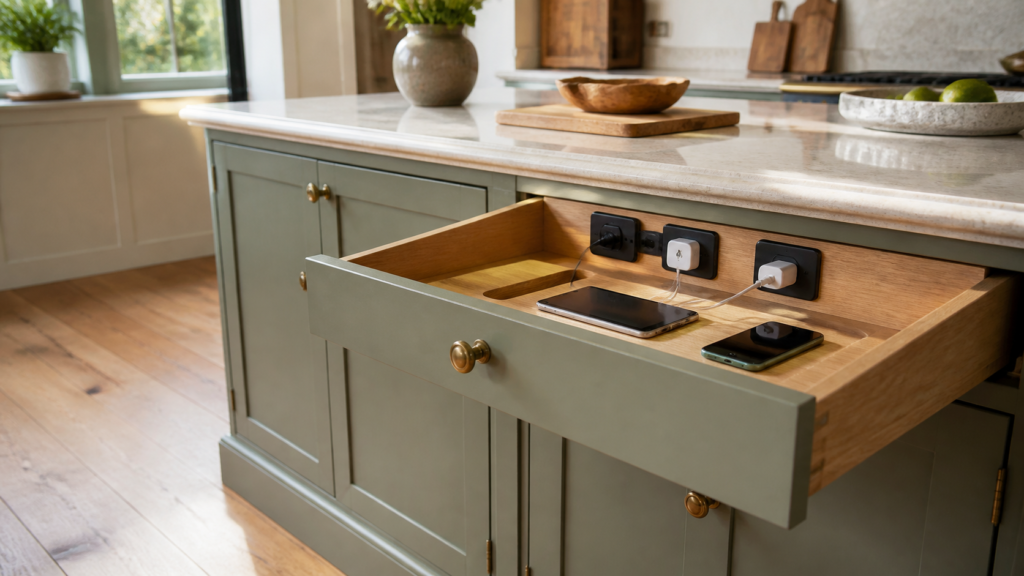
Integrated kitchen charging drawers are one of those details that sound small until you live with the finished kitchen. Phones, tablets, headphones, school laptops, battery packs and recipe screens all need somewhere to charge. If they are not planned into the joinery properly, they end up scattered across the worktop with cables trailing behind the toaster.
Honest truth is, most kitchens now have more small devices than people in the house. That is not going backwards. The trick is not to pretend the cables do not exist. The trick is to give them a proper home, with power in the right place, enough ventilation, sensible access, and joinery that still looks like part of the kitchen rather than an afterthought.
Why integrated kitchen charging drawers are worth planning early
The best time to think about integrated kitchen charging drawers is before the cabinets are made, not once the electrician has gone and the worktops are templated. Power positions, drawer depth, cable routes and socket access all affect how the drawer needs to be built.
We have seen this go wrong plenty of times. A homeowner asks for a charging point late in the job, so a socket gets squeezed into the nearest cupboard. It works, technically, but it is awkward to reach, the cables get trapped by the drawer runner, and nobody uses it after the first week. That is not bespoke joinery doing its job.
When it is planned from the start, the drawer can be made around the way the household actually lives. That might mean a shallow oak tray drawer for phones and watches, a deeper cupboard section for tablets and laptops, or a hidden charging shelf inside a breakfast cupboard. The important bit is that the joinery, electrics and daily routine all line up.
Where integrated kitchen charging drawers work best
Not every drawer should become a charging drawer. A good joiner will look at the kitchen layout and ask where devices naturally land during the day. That is usually near the entrance to the kitchen, beside the island, close to the kettle, or inside a tall cupboard that already works as a household command point.
For families, a charging drawer near the end of a run can stop school tablets and phones taking over the prep space. For open-plan kitchens, a hidden charging point in the island keeps the worktop cleaner, especially if the island doubles as a homework spot or informal desk. For smaller kitchens, a charging shelf inside a larder or breakfast cupboard can do the same job without losing a full drawer.
The worst place is wherever happens to be easiest for the socket. That is how you end up crawling into a corner cabinet to unplug a cable. The right place is where the drawer will be used without thinking.
The joinery matters more than the gadget
There are plenty of ready-made charging inserts, pop-up sockets and USB modules on the market. Some are decent. Some feel flimsy after a few months. In our experience, the clever bit is not the gadget itself. It is how the drawer is made around it.
- The socket needs to be fixed securely, not wobbling in a thin panel.
- Cables need a clear route so they do not snag on runners or hinges.
- The drawer needs enough depth for plugs, adapters and real devices, not just a showroom phone.
- There should be enough space to lift devices in and out easily.
- Any access panel should be tidy but still removable if something needs replacing later.
That last point matters. Electrical fittings can change. USB standards change. Families change what they use. A bespoke charging drawer should not be built like a locked box that has to be ripped apart if a socket fails. Good joinery gives you a neat finish and sensible future access.
Think about heat, access and habits
A closed drawer full of charging devices needs a bit of common sense. Most phones and tablets do not throw out huge amounts of heat, but laptops, larger batteries and multiple adapters can get warm. That does not mean you need ugly vents all over the kitchen. It means the drawer or cupboard needs to be designed with enough breathing space and sensible use in mind.
Access is just as important. If a drawer is too shallow, plugs fight with the back panel. If it is too deep, everyone piles paperwork on top of the devices and forgets what is in there. If it is too far from where people sit, it becomes a nice idea that nobody uses. Worth getting right the first time.
Before choosing the final position, it helps to think through a normal day. Where do phones get dumped when people come home? Does anyone use a tablet for recipes? Do the children charge devices in the kitchen overnight? Does someone work at the island? These are not fancy design questions. They are practical fitting questions, and they make the finished kitchen easier to live with.
How to keep cables off the worktop
The main reason people ask for integrated charging is simple: they are fed up with cables on the worktop. A bespoke approach gives you a few neat options.
- Charging drawer: good for phones, watches, earbuds and smaller tablets.
- Charging cupboard: better for larger devices, shared family tech and bulkier adapters.
- Island socket with hidden cable route: useful when the island is used for working, homework or recipes.
- Breakfast cupboard power: handy if you want the coffee machine, toaster and device charging in one hidden working zone.
The right answer depends on the kitchen. A compact galley may only need one tucked-away shelf. A busy family kitchen might need a proper charging drawer plus sockets where people actually sit. Bespoke joinery lets the solution fit the room instead of forcing the room to fit a standard insert.
Integrated kitchen charging drawers still need an electrician
Joinery and electrics need to work together here. The cabinetmaker can plan the drawer, cable routes, access panels and fixing points, but the power itself must be installed safely by a qualified electrician. That should be coordinated before the cabinets are fitted.
It is also worth deciding whether you want standard sockets, USB-C outlets, or a mix. Standard sockets give you flexibility because adapters can be changed. USB-C is tidy and useful, but standards move on. In many kitchens, a mix is the most practical answer: proper sockets for flexibility, with USB where it genuinely earns its place.
Do not forget isolation and access. If something trips, fails or needs replacing, nobody should have to dismantle half the kitchen to get to it. That is the difference between a clever detail and a nuisance hiding behind a nice drawer front.
A small detail that changes how the kitchen feels
Integrated kitchen charging drawers will not be the first thing visitors notice. That is probably the point. The best practical details are often the ones that disappear into the rhythm of the room.
But you will notice it every day when the worktop is clear, the cables are not tangled behind the kettle, and everyone knows where their devices live. It is not about turning the kitchen into a tech hub. It is about making modern life sit more neatly inside proper joinery.
Thinking about a new kitchen or a bit of bespoke joinery that actually works around daily life? Give us a call on 07904 794280 or message us on Facebook. We are always happy to talk through what is possible and what is worth doing properly.