

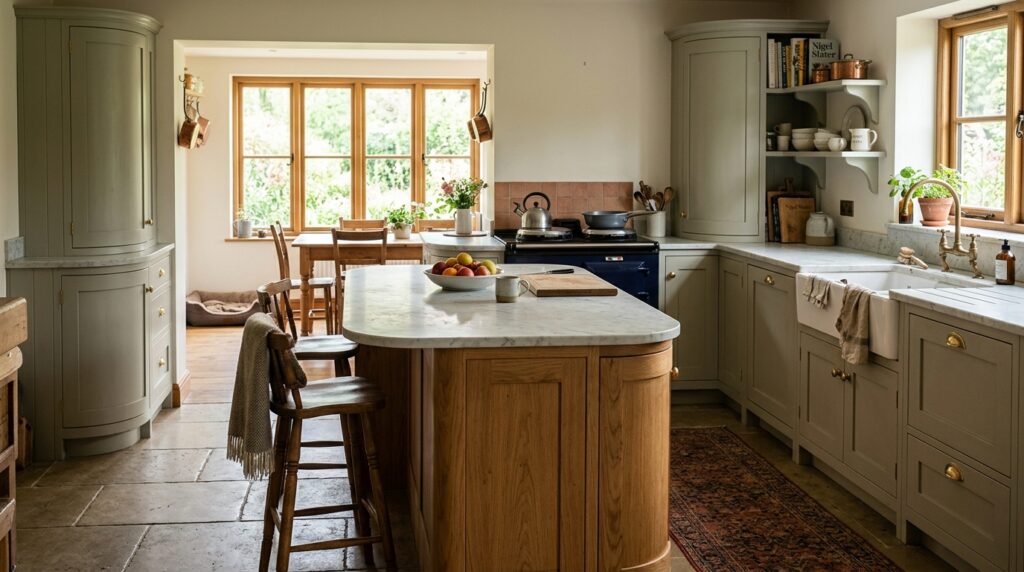
Curved kitchen joinery is one of those ideas that can either look brilliant or completely overcooked, and the difference usually comes down to restraint. In 2026, more homeowners are asking about softened corners, rounded end panels and curved feature pieces because kitchens are doing more than one job now. They are walkways, family hubs, homework zones and entertaining spaces all in one. When a room gets used that hard, sharp corners start to feel a bit clumsy. Done properly, curved kitchen joinery can make the room flow better, feel calmer and look more considered without turning the whole place into a design gimmick.
Why curved kitchen joinery is gaining attention in 2026
A lot of kitchen trends come and go because they photograph well on Instagram and fall apart in real life. This one is a bit different. The reason curved details are getting more attention in 2026 is because people are moving away from cold, hard-edged rooms and towards spaces that feel easier to live in. After years of ultra-flat slab kitchens and boxy islands, plenty of homeowners want something with a bit more softness and character.
We are also seeing more open-plan and broken-plan layouts where the kitchen is visible from several angles. In those spaces, a rounded corner or a gently curved end panel can stop a run of cabinetry looking too harsh. Honest truth is, when you walk past a kitchen every day, those little details matter more than people think. They change how the room feels, not just how it looks in a brochure.
There is a practical side too. Families with children, tighter walkways and busy islands all benefit from taking the sting out of sharp corners. It is the kind of thing you notice every day once it is fitted, especially if your kitchen gets properly used rather than just admired from a distance.
Where curved kitchen joinery genuinely helps
This is the important bit. Curves are worth doing where they solve a problem or improve the shape of the room. They are not worth forcing into every cabinet just because the idea sounds fashionable.
- Island corners, probably the most useful place for a curve. Kitchen islands attract traffic from every direction. Softening the corners helps the room feel less stop-start, and it is kinder on hips, thighs and small heads too.
- Curved end panels, especially on exposed cabinet runs. If the end of a kitchen is fully visible from the dining area or hallway, a curved end panel can give it a more finished, furniture-like look.
- Peninsulas, where space is tighter and people tend to squeeze past. A gentle radius on the outer edge can improve movement without reducing the whole worktop to something awkward.
- Feature pieces, such as a curved breakfast cupboard surround, a drinks station or a built-in dresser. Used once, in the right spot, it can give the room a bit of personality.
In our experience, those are the areas where curved kitchen joinery earns its keep. Once you start trying to bend every line in the room, the design usually starts fighting itself.
When softened edges are worth the extra work
There is no point pretending curves are the cheapest route. They usually mean more labour, more careful templating and more thought in the workshop. So when are they actually worth paying for?
First, when circulation is awkward. If you have a narrow route between an island and bi-folds, or a pinch point between kitchen and dining area, easing that corner can make the room feel less cramped. Second, when the kitchen is part of a larger living space and you want it to read more like fitted furniture than a row of boxes. Third, when the rest of the design is quite simple and you want one or two details to lift it.
A good rule is this, curves should improve either movement, comfort or appearance in a clear way. If they do all three, even better. If they do none of those and are there just to look different, save your money. There are better places to spend it, like better drawers, better hinges or a worktop material that will still look good in ten years.
How to avoid gimmicky curved kitchen joinery
We have seen this go wrong plenty of times. The usual mistake is treating curves like a theme rather than a detail. One rounded island end can look smart. Five different curved sections, plus fluting, plus bold colours, plus odd handles, starts to feel like everyone got a bit carried away.
The best curved kitchen joinery is usually subtle. Think soft radiused corners, not sweeping nightclub shapes. It should still suit the style of the house as well. A calm painted shaker kitchen can take a curved island corner beautifully. A heavily detailed traditional kitchen might prefer shaped end panels or gentle moulded transitions rather than obvious bends everywhere.
A good joiner will also think about proportion. Tight, mean-looking curves often feel accidental. Overblown ones can eat into storage and look forced. The radius needs to belong with the cabinet depth, the worktop profile and the room itself. That is why this sort of detail is worth getting right the first time, because once it is made, changing it is not a quick fix.
Materials and finishes that work well with curves
Some materials handle curves far better than others. If you are thinking about softened edges, it helps to choose finishes that suit the shape rather than fighting it.
- Painted timber and veneered boards work well because they can be shaped cleanly and finished in a way that still feels warm and solid.
- Solid surface worktops are often a good match where you want a rounded top to echo the cabinetry below. They can take a smooth profile nicely.
- Quartz and stone can work too, but the detailing needs planning. Not every fabricator will execute a curved section neatly, so this is one to discuss early.
- Natural wood details, especially on breakfast bars, shelves or feature end panels, can stop curves feeling too polished or synthetic.
Muted painted colours, warmer timber tones and brushed metal accents all tend to suit curved forms better than very stark finishes. That is because curves naturally soften a kitchen, so materials with a bit of depth and texture usually make more sense. High-contrast, glossy finishes can make every bend shout at you, which is rarely the aim.
The honest truth is, curved details look best when the craftsmanship is obvious but the effort is not. You should notice that the kitchen feels better, not feel like the room is trying too hard to impress you.
Curved kitchen joinery works best when the room still feels balanced
If you are considering curved kitchen joinery in 2026, the sensible approach is to pick one or two places where it genuinely improves the room and leave the rest alone. That might be an island corner, a curved end cabinet or a feature dresser that softens a straight run. Small decisions like that often have more impact than a long list of trendy add-ons.
Good kitchen design is rarely about cramming in every idea you have seen online. It is about knowing what suits the house, what suits the way you live, and what will still feel right after the novelty has worn off. Curves can absolutely be worth it, but only when they are properly made and properly placed.
Talk to BH Bespoak
If you are planning a new kitchen and want honest advice on whether curved kitchen joinery is worth doing in your space, talk to BH Bespoak. We can help you work out where softened edges will improve the room, where straight lines make more sense, and how to get the balance right. Give us a call on 01482 650 101 or message us on Facebook, we are always happy to talk through ideas properly.