

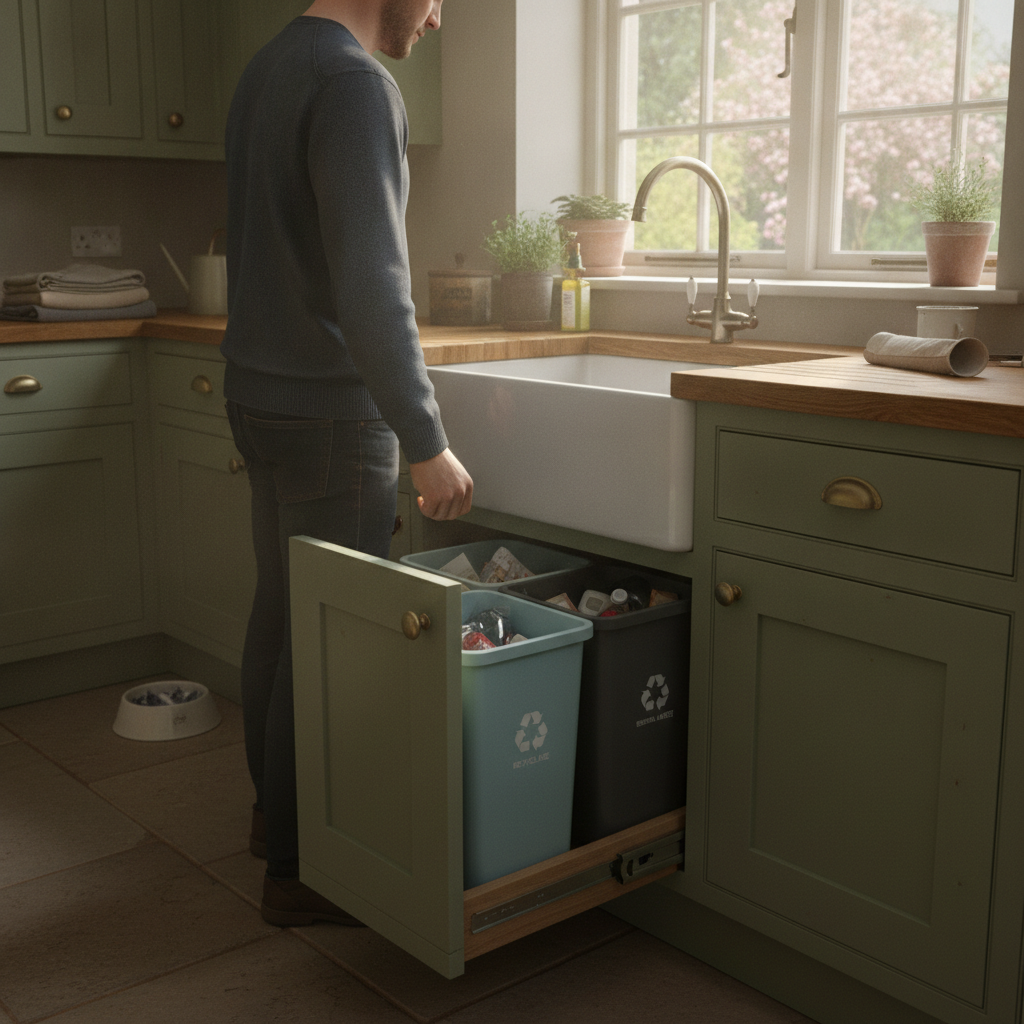
Something changed in kitchens this year that has nothing to do with cabinet colour or worktop material. Simpler recycling collections rolled out across England through 2026, and most households are now sorting waste into five separate streams: food waste, paper and card, glass, plastic and cans, and general rubbish. That is a lot more bins than most kitchens were ever built to hold, and it is quietly becoming one of the biggest design headaches we deal with on new fitted kitchens.
In our experience, bin storage used to be an afterthought. A single pull-out under the sink, maybe a second bin squeezed in beside it, job done. That approach does not work any more. If you are planning a kitchen this year, kitchen bin storage needs to be part of the brief from day one, not something you try to solve once the cabinets are already ordered.
Why kitchen bin storage has become a real design problem in 2026
Five waste streams sounds manageable until you actually try to fit five containers somewhere sensible. Add a food caddy that needs emptying daily, a bin for general waste that still needs to be reasonably sized, and separate compartments for glass, paper and plastic, and you are looking at a serious amount of cabinet space. Most existing kitchens simply were not designed with that in mind, which is why we are seeing more calls about reworking under-sink units, utility cupboards and even hallway storage to cope.
The honest truth is that councils are not going to make this easier any time soon. Waste separation is only going one direction. A kitchen designed around proper bin storage now will still work in five years. One that ignores it will need reworking sooner than you think.
How many bins does a kitchen actually need now
This depends on your household and your council, but as a general rule we now design for at least four compartments as standard: general waste, mixed recycling or separated glass and cans, paper and card, and a small food waste caddy. Larger families, or households that recycle heavily, often want a fifth compartment for glass specifically, since broken glass mixed with paper or plastic causes problems at collection.
A good joiner will ask about your council’s collection setup before drawing anything up. There is no point designing a beautiful five-bin pull-out if your local authority still collects general recycling as one stream. Get the actual requirement right first, then build the joinery around it.
Pull-out bin drawers versus a dedicated utility cupboard
There are two sensible approaches, and which one works depends on how much space you have. A pull-out bin drawer under the sink or in a base unit keeps everything close to where waste is actually generated, which is where most people want it. Good pull-out mechanisms are soft close, easy to lift out for cleaning, and sized so the bin liners do not tear every time you fill them.
Where space allows, a dedicated utility cupboard or bin store, sometimes tucked into a boot room or utility area, is worth considering. It keeps bins and recycling out of the main kitchen entirely, which some homeowners much prefer, particularly if the kitchen opens into a dining or living space. It does mean a slightly longer walk to sort your rubbish, so it suits some households better than others.
We have seen this go wrong plenty of times when the compromise is a half-measure: a single pull-out crammed with more bins than it was ever designed for, wheels catching on the drawer runners, lids that will not shut properly. If you are not sure which approach suits your home, it is worth talking it through properly before the cabinets are ordered.
Getting the sizing right so bins actually fit
This is where a lot of kitchens fall down. Standard bin pull-outs are often sized for two containers, and squeezing in a third or fourth compartment means going smaller on each one, which then means emptying them more often. Before we design a bin storage unit, we measure the actual bins the household plans to use, not a generic size off a supplier’s spec sheet. It sounds obvious, but it is the kind of detail that gets missed when a kitchen is designed in a hurry.
Cabinet width matters too. A 600mm base unit will comfortably take a two or three bin system. Anything beyond that usually needs 900mm or a dedicated run, which has knock-on effects for the rest of the kitchen layout. Sort this out at the design stage, not once the carcasses are built.
Ventilation and hygiene details worth building in
Food waste caddies and general waste bins both benefit from proper airflow, particularly through summer. Vented doors or a small gap at the base of the cabinet help stop smells building up, and a removable liner tray at the bottom of the cupboard makes cleaning up spills far easier than trying to wipe out a full depth cabinet. These are small details, but they are the kind of thing you notice every day once the kitchen is in daily use.
Worth getting right the first time is a soft-close mechanism rated for the actual weight of a full bin, not just an empty one. Cheap runners fail quickly once they are carrying real weight several times a day, and replacing a failed bin drawer mechanism after eighteen months is a false economy.
Where we would put bin storage if we were designing your kitchen
If space allows, our preference is a run near the sink for day to day general waste and food caddy, with a separate cupboard or utility area handling paper, card and glass, which do not need emptying as often and can sit slightly further away. That split keeps the kitchen tidy without making daily recycling a chore.
- General waste and food caddy: pull-out drawer beside the sink for daily convenience
- Paper, card and mixed recycling: dedicated cupboard or utility area, emptied weekly
- Glass: separate small bin, kept away from paper to avoid contamination
- Bin liners and spares: a slim drawer nearby so replacements are never a hunt
None of this needs to compromise how the kitchen looks. Done properly, bin storage disappears behind a normal-looking cabinet front and nobody visiting your home would know it is there. That is the whole point of bespoke joinery: it solves the practical problems without the kitchen looking like it is built around them.
Thinking about a new kitchen or a rework of your existing storage to handle the new recycling rules properly? Give us a call on 07904 794280 or message us on Facebook. We are happy to talk through what will actually work for your household and your council’s collection system.