

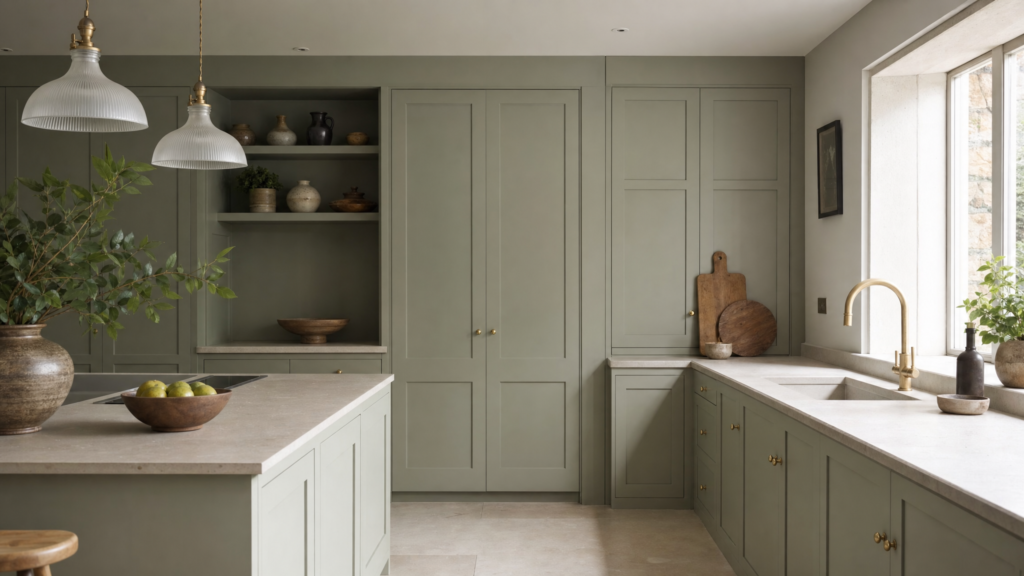
There’s a moment when you walk into a kitchen that’s entirely committed to one colour and you either think “this is the most beautiful room I’ve ever seen” or “this is a mistake.” The difference between those two reactions comes down almost entirely to craftsmanship. And that’s exactly why the monochromatic kitchen is having such a strong moment in 2026.
It’s not a new idea. Designers have talked about monochromatic schemes for years. But in 2026 it’s gone mainstream in a way that’s produced some genuinely stunning kitchens and, equally, a fair number of cautionary tales. At BH Bespoak, we’ve been fitting bespoke kitchens across the Midlands long enough to know the difference. This post is about what actually makes the look work.
What a Monochromatic Kitchen Actually Means
Let’s be clear about terms. A monochromatic kitchen doesn’t mean everything is painted the same shade and left at that. It means the colour palette is built from a single base hue, with variation coming from tone, texture, and material rather than from switching colours.
So a sage green kitchen might have painted cabinet doors in one tone, a slightly deeper green on the island, a honed green limestone worktop, and green-veined tiles on the splashback. Every element speaks the same language. The interest comes from how those materials play off each other, not from throwing in a contrasting colour to break things up.
Done properly, it creates a kitchen that feels cohesive, considered, and genuinely high-end. Done badly, it looks flat and unfinished.
Why It Works So Well in Bespoke Joinery
Here’s something off-the-shelf kitchens simply cannot replicate: the ability to calibrate. When you’re working with a joiner on a fully bespoke kitchen, every decision is deliberate. The reveal on each door. The profile of the frame. The way light catches a lipped drawer front versus a flush one. These are the details that make a monochromatic scheme come alive.
With a standard kitchen, you pick from a catalogue. The proportions are what they are. The finish is what it is. You can paint it any colour you like, but the lack of joinery detail means there’s nothing to create the textural variation that a one-colour scheme depends on.
Bespoke joinery gives you the tools to make monochromatic actually work. In-frame construction creates natural shadow lines around every door. Vary the depth of a raised panel and you change how light falls across it. Mix a painted base with a natural timber top in the same tonal family and you’ve got contrast without breaking the colour story.
The Colours That Are Working in 2026
We’re seeing a few clear frontrunners this year.
Sage and muted greens remain the most popular by a distance. They’re soft enough to feel liveable, but green has enough depth to carry a full kitchen without feeling clinical. Pair it with pale grey-green limestone or a white-veined quartz and it sings.
Warm off-whites and stone tones are having a strong moment, particularly in older properties where sharp whites have always felt a bit wrong. These work brilliantly with natural timber elements that stay within the same warm palette. Think aged oak, limed ash, or a light-toned walnut. Not all three together, but one, chosen deliberately.
Deep blues and slate are the choice for people who want drama. Navy or deep teal across all units is a commitment, and it pays off when the rest of the room has been thought through carefully. Brushed steel or brass hardware, a dark honed worktop, considered lighting. It’s a serious kitchen and it needs a confident brief.
What we’re seeing less of is the all-grey kitchen that defined the previous decade. Grey isn’t gone, but the cold, flat greys of 2015 are giving way to warmer putty tones that sit more naturally in UK homes with their notoriously tricky natural light.
What Goes Wrong (and How to Avoid It)
The most common mistake is treating monochromatic as monotonous. A kitchen where everything is the same paint colour, the same finish, and the same material is dull. The scheme requires variation within its constraints, not an absence of variation.
The second mistake is ignoring the floor. Your floor is one of the largest surfaces in the room. If it clashes with the scheme, the whole thing falls apart. If you’re planning a monochromatic kitchen, the floor needs to be part of the brief from day one, not an afterthought once the units are ordered.
The third mistake is poor lighting. A monochromatic scheme depends on light to reveal texture and depth. A single ceiling pendant doesn’t do that job. Under-cabinet lighting, internal lighting in open shelving, and a mix of task and ambient sources are what transform a flat-looking kitchen into something that genuinely shifts with the light throughout the day.
Finally, don’t conflate monochromatic with minimal. You can have a busy, lived-in kitchen that happens to be monochromatic. The two things are completely independent. A monochromatic scheme is a colour decision, not a lifestyle prescription.
Is It Right for Your Kitchen?
The honest answer is: it depends on your brief. A monochromatic kitchen rewards investment in joinery quality because there’s nowhere to hide. Every detail is visible. Every proportion matters. If you’re planning a bespoke kitchen and want something that feels genuinely considered rather than just fashionable, a well-executed monochromatic scheme is one of the strongest directions you can take in 2026.
If your goal is something more layered or eclectic, there are better approaches. But if you want a kitchen that feels complete, coherent, and like it was made specifically for your home, the monochromatic approach done properly is very hard to beat.
Talk to Us About Your Kitchen
BH Bespoak designs and fits bespoke kitchens across the West Midlands and surrounding areas. If you’re thinking about a new kitchen and want to talk through ideas, including monochromatic schemes, unusual material combinations, or anything else you’ve seen and wondered about, we’d love to hear from you.
Call us on +447749 932 689, drop us a message via our contact page, or find us on Facebook to see examples of our recent work.