

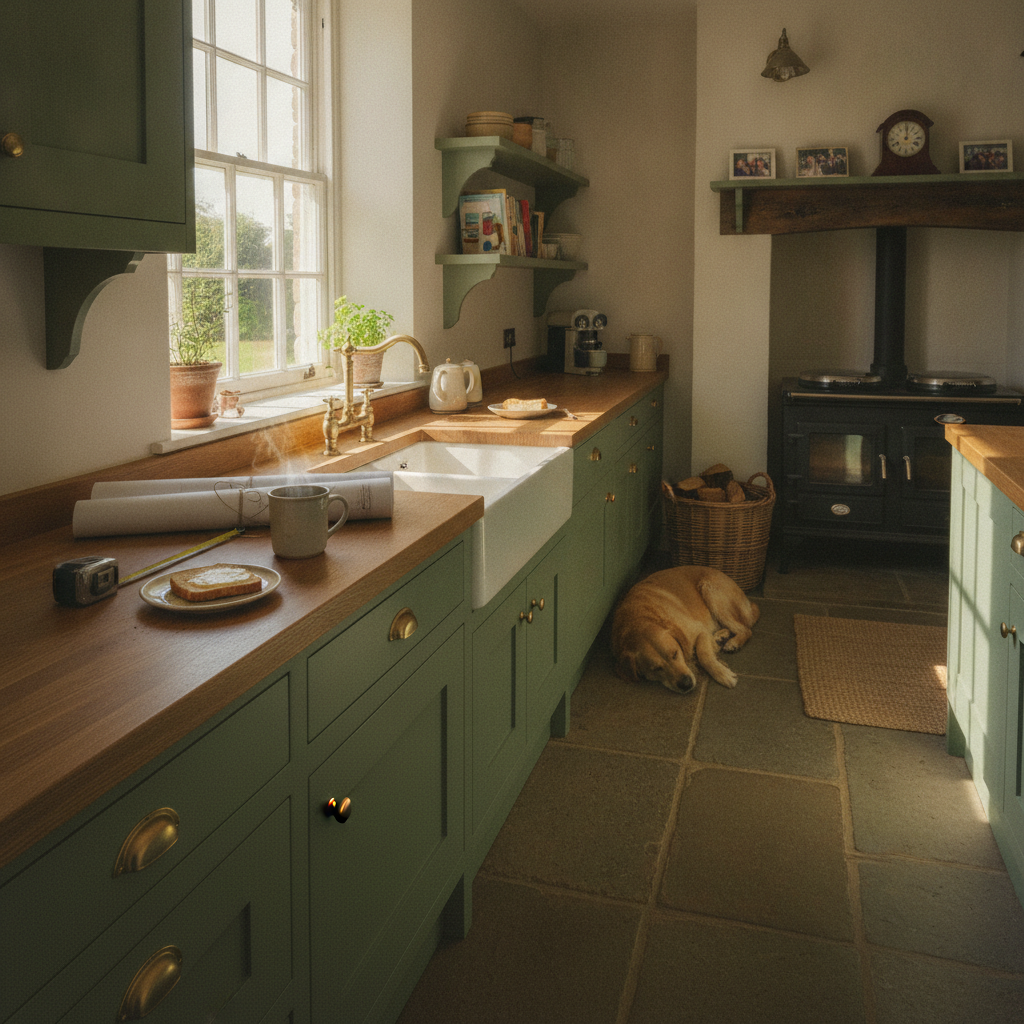
Every year we get asked the same question earlier and earlier: “roughly what does a bespoke kitchen cost?” It is a fair question, and it is one that a lot of joiners dodge because the honest answer depends on so much. But going into 2026, homeowners are planning further ahead and want real numbers, not vague ranges. So here is where the money actually goes when you commission a bespoke kitchen, and why the breakdown matters more than the headline figure.
Why bespoke kitchen budgeting is different to flat-pack
With a flat-pack kitchen you are buying a fixed product. The price on the shelf is roughly the price you pay, give or take delivery and fitting. With bespoke joinery, you are commissioning a piece of work built specifically for your space, and that changes how the costs stack up. Materials, labour hours, hardware, finish and complexity all move independently of each other, which is why two kitchens that look similar on paper can come in thousands apart.
In our experience, the homeowners who end up happiest with their budget are the ones who understand roughly where each pound is going before the quote lands, not after.
The main cost blocks in a bespoke kitchen
Strip a bespoke kitchen quote back and it almost always breaks down into the same handful of areas. Understanding these makes it much easier to see where you can flex if the total needs to come down.
- Carcass construction – the boxes behind your doors. Solid ply and birch ply cost more than standard MDF carcasses but last decades longer and take heavy use better.
- Doors and finish – painted in-frame doors, shaker fronts or veneered panels all carry different labour and material costs. Hand-painted finishes take time, and time is the biggest cost driver in bespoke work.
- Worktops – solid wood, quartz and natural stone sit at very different price points, and installation complexity (upstands, drainer grooves, mitred joins) adds on top.
- Hardware – hinges, runners, pull-out mechanisms and handles vary hugely in price and quality. Cheap hardware fails first and is the thing people regret skimping on.
- Fitting labour – this covers installation, levelling, scribing to your walls (which are never as straight as you think) and finishing details like end panels and pelmets.
Where people overspend without realising
Honest truth is, the overspend rarely happens where people expect it. It is not usually the worktop or the door style that blows a budget. It is the small decisions made mid-project: an extra drawer added here, a change of handle style there, a last-minute request to extend a run of cupboards by 300mm. Each change feels minor on its own, but they add up fast because bespoke work is priced on the job as specified, and every variation touches material, labour and sometimes design time too.
We have seen this go wrong plenty of times where a client’s budget crept up by fifteen or twenty percent purely through additions made after the quote was signed off. It is not that the additions were bad decisions. It is that nobody totted up the running cost as they went.
Where it pays to spend, and where you can save
If your budget is tight, there are sensible places to trim without regretting it later. Standardising cupboard widths where possible reduces cutting and labour time. Choosing a simpler door profile over an elaborate one saves on both material and finishing hours. Painted MDF doors, done well, can look every bit as good as timber for a fraction of the cost.
Where we would always tell a client to spend the money is on hardware and carcass quality. These are the parts of a kitchen you touch every single day and the parts hidden once the doors are on, so cheap corners there cost you more in the long run through repairs and replacements. A good joiner will tell you the same, even if it is not what you want to hear when you are trying to save a few hundred pounds.
Getting an honest quote
The best way to budget properly is to get a breakdown, not just a bottom line figure. Ask your joiner to itemise carcasses, doors, worktop, hardware and fitting separately. It is the kind of thing you notice every day once you have it, because it means you can see exactly where a change in spec moves the number, rather than getting a surprise total at the end.
It is worth getting right the first time. A kitchen is not something most people redo every five years, so building in a realistic budget from the start, with a small contingency for the inevitable site surprises, saves a lot of stress later.
Thinking about a new kitchen or joinery project and want a straight-talking, itemised quote to work from? Give us a call on 07904 794280 or message us on Facebook. We are always happy to talk through what is possible and what it actually costs.