

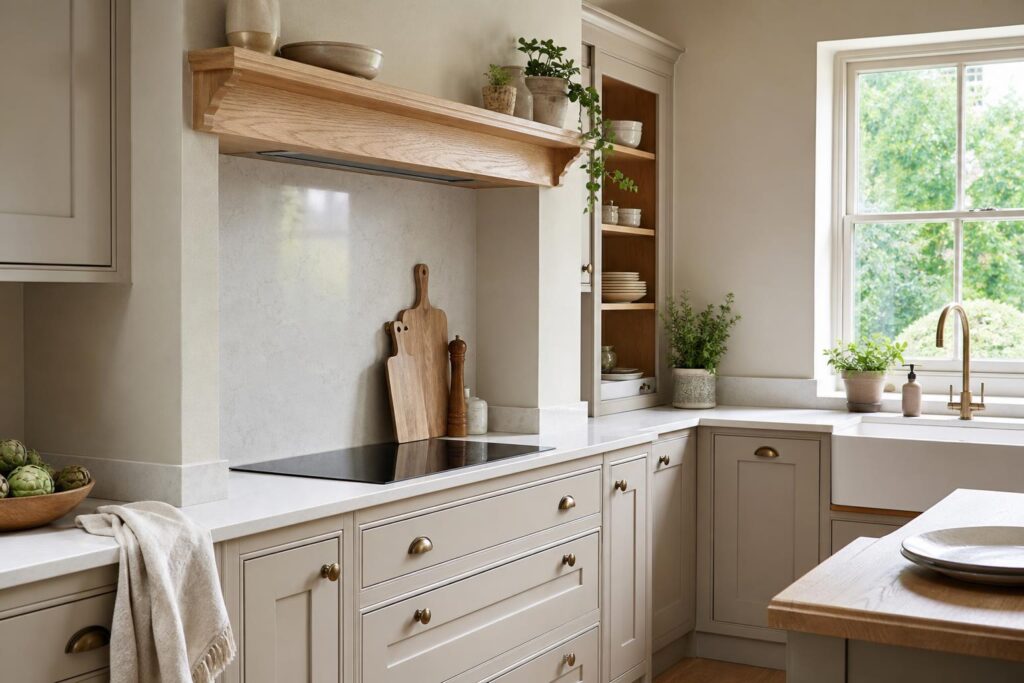
Full-height kitchen splashbacks are one of those details that sound like a design choice at first, but they very quickly become a day-to-day living choice. Instead of stopping a small tile or upstand a few inches above the worktop, the material carries right up the wall, often to the underside of a shelf, an extractor, or the wall cupboards. Done well, it looks calm, tidy, and properly fitted. More importantly, it makes the messier parts of the kitchen much easier to clean.
We are seeing more UK homeowners ask about them in 2026, especially with quartz, stone-effect porcelain, compact laminate, and solid surface materials. It makes sense. People want kitchens that feel warm and made-to-measure, but they are also fed up with grout lines, awkward little returns, and walls that mark every time someone cooks pasta sauce.
Why full-height kitchen splashbacks are getting more popular
The honest truth is, a lot of kitchen trends look good in a showroom and then annoy you at home. Full-height splashbacks are popular because they solve a real problem. Behind a hob, sink, coffee machine, or prep area, the wall takes a beating. Steam, splashes, oil, water marks, and crumbs all end up there.
Tiles can still be a lovely choice, especially in the right house, but they come with grout. Grout changes colour, collects grime, and is never quite as wipe-clean as people hope. A single slab or large panel gives you fewer joints and a much cleaner finish. It also lets the cabinetry and joinery do the talking, rather than breaking the wall up into lots of little lines.
That is why this detail works so well with bespoke kitchens. If the cupboards are built properly, the worktop is templated well, and the wall finish lines up neatly with shelves, extractors, window reveals, and sockets, the whole kitchen feels more considered. It is not shouting for attention. It just looks settled.
Where a full-height kitchen splashback earns its keep
You do not need to cover every wall in the kitchen. In fact, in many homes, that would be overkill. The best results usually come from using a full-height kitchen splashback where it does a proper job.
- Behind the hob, where grease and steam are constant
- Behind the sink, especially if there is a window reveal or deep sill
- Inside a breakfast cupboard or coffee station
- Behind an open shelf where the wall would otherwise mark quickly
- On a short feature run where the worktop can carry up the wall cleanly
In our experience, the hob wall is the one most worth getting right. It is the area people notice, and it is the area that gets the hardest use. If you cook every day, a wipe-clean panel behind the hob is not a fancy extra. It is common sense.
Materials that work well for full-height kitchen splashbacks
Quartz is probably the most talked-about option, mostly because homeowners like the idea of the worktop and splashback matching. It gives a very clean finish and can be brilliant in a busy family kitchen. Porcelain is also worth looking at, especially where heat resistance and thinner panels matter. Solid surface materials can work nicely too, particularly where you want subtle joints and a softer look.
Natural stone can be beautiful, but it needs a bit more thought. Some stones need sealing, some mark more easily than people expect, and some are better suited to a careful household than a kitchen that gets hammered every evening. A good joiner or fitter should be honest about that. There is no point choosing a material that makes you nervous every time someone puts a mug down.
Timber can look fantastic as a feature, but behind a hob or sink it needs proper protection and the right detailing. We would not throw it into every kitchen just because warm wood is having a moment. Wood moves, water finds gaps, and heat is not always kind. Used in the right place, it can be lovely. Used lazily, it becomes a maintenance problem.
The fitting details matter more than the trend
A full-height splashback looks simple, which is exactly why the fitting matters. The eye spots poor setting-out straight away. Socket positions, extractor heights, shelf brackets, window edges, and cabinet lines all need thinking through before anything is cut.
We have seen this go wrong plenty of times. A socket ends up too close to an edge. A panel stops short for no good reason. A patterned slab is cut without considering where the veining lands. The splashback itself might be expensive, but it is the planning that makes it look right.
If you are planning a bespoke kitchen, talk about the wall finish early. Do not leave it until the cabinets are fitted and everyone is trying to make a last-minute decision. The splashback affects electrics, extraction, worktop templating, shelving, and sometimes even the depth of the units. Worth getting right the first time.
What style of kitchen does it suit?
Full-height kitchen splashbacks are often shown in very modern kitchens, but they can work just as well with classic joinery. A pale quartz or softly veined stone-effect panel behind painted shaker doors can look warm and practical, not cold or showroom-like. The key is restraint. Let the material support the cabinetry, rather than fighting it.
They also work well in smaller kitchens. Fewer breaks on the wall can make a compact run feel calmer, and a reflective or lightly polished finish can help bounce light around. That said, darker or heavily patterned panels need care in a small room. They can look brilliant, but they can also become the only thing you see.
Is a full-height splashback worth the extra cost?
It depends where you use it. Covering every wall in a premium slab can push the budget up quickly. Using it behind the hob, sink, or main working run is often a better balance. You get the practical benefit where it matters, without spending money just to follow a trend.
Our advice is simple. Spend money on the parts you touch, clean, and look at every day. A full-height splashback in the right place can make the kitchen easier to live with and better finished. In the wrong place, it is just an expensive sheet on a wall.
Thinking about a new kitchen or bespoke joinery project? Give us a call on 07904 794280 or message us on Facebook. We are always happy to talk through what will actually work in your home.