

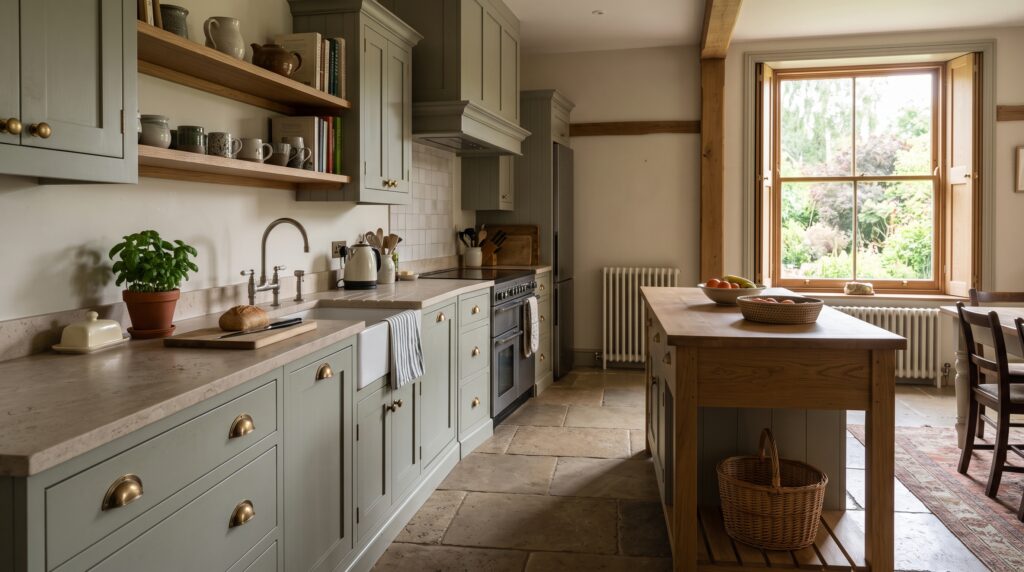
Honed stone worktops are showing up in more 2026 kitchen plans, and it is easy to see why. They look calmer than polished stone, they sit well with timber and painted joinery, and they do not give a kitchen that shiny showroom feel. But there is a catch: honed stone worktops need proper planning before the kitchen is fitted.
In our experience, the finish itself is rarely the problem. The trouble starts when the worktop is treated as a separate choice at the end, after the cupboards, sink, appliances and splashbacks have already been decided. By then, you are trying to make an expensive material work around decisions that should have been made together.
Why honed stone worktops are popular in 2026 kitchens
A honed finish has a softer, more matt surface than polished stone. It takes the glare off the room and gives the worktop a quieter look. That suits where kitchen design has been heading recently: warmer colours, real materials, painted cabinets, timber details and spaces that feel lived in rather than spotless and cold.
It also works well in older houses, cottages, extensions and family kitchens where a mirror-like worktop can look a bit out of place. Honed quartz, granite, marble-effect surfaces and natural stones all have their own character, but they share that same softer appearance.
Honest truth is, a honed worktop can make a kitchen feel more expensive without shouting about it. But only when the joinery underneath has been designed properly. A lovely slab on top of poorly planned cupboards still feels wrong every time you use it.
Honed stone worktops need the right cabinet support
Stone is heavy. That sounds obvious, but it is one of those basics that gets skipped when people focus on colours and samples. The cabinets below need to be level, strong and fitted accurately. If the units are out, the worktop fitter has a harder job, and the finished kitchen can suffer for it.
This matters even more with long runs, large islands, overhangs and cut-outs for hobs or sinks. You need to think about where the weight is going, where extra support is needed, and how the doors and drawers below will line up once everything is installed.
A good kitchen fitter will not just say, “the stone company can sort that”. The joinery and worktop have to work as one job. That means solid fixing, accurate levels, sensible carcass construction and no guessing around awkward corners.
Plan the edge detail before you commit
The edge of a worktop changes the whole feel of a kitchen. A thin, crisp edge looks modern and neat. A thicker edge can feel more traditional and substantial. A rounded or softened edge can be a good choice in a busy family kitchen where sharp corners take knocks.
With honed stone worktops, the edge detail is especially noticeable because the surface is not bouncing light around like polished stone. You see the shape and shadow more clearly. That edge also affects the drawer fronts below, the look of the end panels and how the worktop meets tall units or open shelving.
Worth getting right before templating day. Once the stone is cut, changing your mind is not simple, and it is certainly not cheap.
Think about sinks, draining grooves and splashbacks early
The sink run is where worktop planning often gets messy. Undermount sinks, Belfast sinks, draining grooves and taps all need accurate setting out. If the sink cabinet is not built to suit the chosen sink, the worktop detail can become a compromise.
Honed stone can show water marks more than a high-gloss surface, depending on the material. That does not mean you should avoid it. It just means the sink area needs thinking through. Do you want grooves cut into the stone? Would a separate drainer be better? Is the tap positioned where it can be cleaned easily? Has the windowsill or upstand been allowed for?
Splashbacks matter too. A full-height stone splashback looks tidy, but it needs measuring and planning carefully around sockets, extraction, shelves and wall cupboards. If tiles are being used instead, the height of the upstand and the cabinet lines still need to make sense together.
Honed does not mean maintenance-free
Some people choose honed stone because they think matt means easy. Sometimes it is. Sometimes it is not. Natural stone may need sealing. Some surfaces show oils, fingerprints or water marks more clearly at first. Quartz and sintered materials vary by manufacturer, so it is worth asking proper questions before ordering.
- How should the surface be cleaned day to day?
- Does it need sealing or special treatment?
- Will darker colours show marks more easily?
- Can samples be tested with water, oil and everyday kitchen mess?
- What happens around the sink and hob after a few years of real use?
We’ve seen this go wrong plenty of times when people choose from a tiny showroom sample. A worktop is not a coaster. It has to cope with tea, sauce, pans, crumbs, children, guests and the odd bit of DIY that really should not be happening on the kitchen island.
Match the stone to the joinery, not just the paint colour
A honed stone worktop should feel connected to the rest of the kitchen. That does not mean everything has to match. In fact, kitchens usually look better when there is a bit of contrast. But the worktop needs to sit naturally with the cabinet style, handles, flooring, wall colour and timber details.
For example, a heavily veined stone can look brilliant on simple, well-made cabinetry. Put the same slab over fussy doors, busy handles and a patterned floor, and the room can start shouting from every direction. On the other hand, a quiet honed stone can be just the thing for stronger paint colours or proper oak details.
This is where bespoke joinery earns its keep. You are not trying to force a standard unit size to suit a slab. The cupboards, panels, gaps and details can be planned around the finished look and the way the kitchen will actually be used.
Do not leave templating decisions until the last minute
Templating day is when the worktop company measures the fitted cabinets ready for cutting the stone. By that point, the main decisions should already be made. Sink, hob, tap, overhangs, upstands, edges, joints and splashbacks all need to be clear.
If decisions are still floating around at that stage, you risk delays or rushed choices. That can hold up the whole kitchen because the worktop often has to go in before final plumbing, hob fitting and finishing touches can happen.
A good joiner will tell you what needs deciding early. Not to be difficult, but because those early decisions are what make the finished kitchen feel properly made rather than cobbled together.
A calmer kitchen still needs proper graft behind it
Honed stone worktops are a strong choice for 2026 kitchens because they suit the way people actually want to live now: warmer, practical, less glossy and more personal. But the best results come from planning the surface with the joinery, not treating it as a finishing touch.
Get the support right. Choose the edge properly. Think hard about the sink run. Ask the boring maintenance questions. Make sure the cabinets and stone are designed together. It is the kind of thing you notice every day once the kitchen is finished.
Thinking about honed stone worktops, a new kitchen or a bespoke joinery project? Give us a call on 07904 794280 or message us on Facebook. We are always happy to talk through what is possible before anything gets measured, ordered or fitted.