

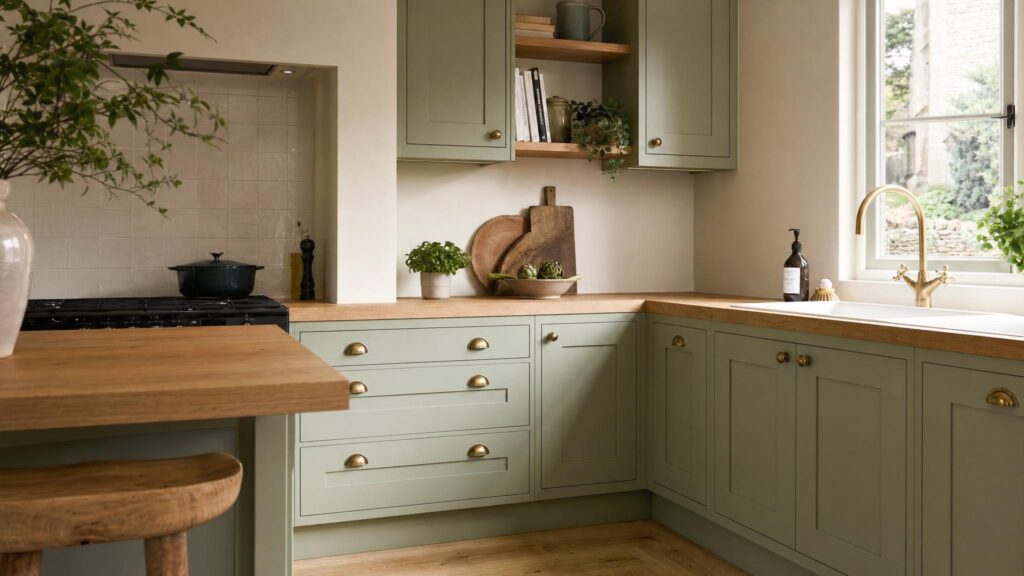
If you have been looking at inset kitchen cabinet doors, you have probably noticed they carry a different feel from a standard fitted kitchen. Even before you know the joinery terms, you can usually spot that something looks sharper, tighter and more deliberate. Honest truth is, that difference is not just style. It tells you a lot about how the kitchen has been made, how carefully it has been fitted, and whether the person pricing the job really understands proper cabinet work.
In our experience, inset doors are one of the clearest signs of kitchen quality because there is nowhere to hide. Gaps need to be even, frames need to be true, hinges need to sit properly, and the whole run of units needs to line through cleanly. Overlay doors can still make a very good kitchen, but inset work asks more from the joiner and the fitter. Worth getting right the first time.
What inset doors actually are, and how they differ from overlay doors
An inset door sits within the cabinet frame rather than covering the front of it. When the door is shut, you can see the face frame around it and a neat reveal all the way round. That is the classic framed look people often associate with traditional shaker kitchens, though it can work just as well in a cleaner, more modern scheme.
An overlay door does the opposite. It closes over the front edge of the cabinet or frame. With a full overlay kitchen, the doors and drawer fronts cover most of the cabinet front, leaving much less of the frame visible, or none at all on a frameless unit. It is a common approach because it is efficient, tidy and easier to manufacture at scale.
Neither system is automatically right or wrong. The important thing is understanding what you are paying for. Inset kitchen cabinet doors rely on precision because the door has to fit exactly inside the opening. Overlay doors give you a bit more forgiveness because the front overlaps the edges and hides more of the cabinet structure.
- Inset doors: set inside a face frame, visible reveal, more traditional joinery-led appearance.
- Overlay doors: sit over the cabinet front, cleaner coverage, usually quicker and simpler to produce.
- Full overlay: a type of overlay with minimal gaps and a flatter overall front.
Why inset doors demand more skill and precision
This is where kitchen quality really shows itself. With an inset kitchen, every opening has to be square, every frame needs to be straight, and every hinge position matters. If a cabinet is even slightly out, the reveal around the door will tell on it straight away. You will see a tight gap on one side, a wider one on the other, or a door that catches and needs forcing shut.
We have seen plenty of kitchens where somebody has priced inset doors as if they were just another shaker front. They are not. A genuine inset job takes more time in the workshop and more care on site. Units need to be made and installed accurately. Floors and walls need to be accounted for. Hinges need proper setting out. Drawer lines need to sit level with surrounding doors. If the fitter rushes, it shows.
That is why inset work tends to sit firmly in the bespoke or properly made-to-measure end of the market. It is not only about having a nice door style. It is about building the cabinet and frame so the door belongs there.
The difference homeowners notice every single day
Most homeowners do not stand in the kitchen talking about reveals and tolerances, but they do notice when a kitchen feels solid, calm and properly finished. Inset doors give you that because the front of the cabinetry has depth. The framed opening, the shadow line around each door, and the way the ironmongery sits all add a sense of craftsmanship you can see and feel.
Tactilely, a good inset door feels different as well. It closes with intent. Hinges tend to feel more substantial. Handles and knobs sit in a more considered position because the frame is part of the design, not something being hidden. It is the kind of thing you notice every day, even if you cannot quite explain why one kitchen feels better than another.
Overlay kitchens can still look excellent, especially when they are well designed and sensibly fitted. But inset doors usually give a room a quieter confidence. The finish feels rooted in joinery rather than just assembly. In period homes, that matters even more because the cabinetry tends to sit more naturally with skirtings, architraves and other detail already in the house.
Why inset doors cost more, and why that can still be money well spent
The straightforward reason is labour. There is more setting out, more machining, more adjustment and more fitting time involved. Materials can also differ, especially if the kitchen is being built with proper framed cabinetry rather than adapted standard units. Add better hinges, careful finishing and extra installation time, and the price naturally rises.
Some people see that and assume inset is just an expensive look. Honest truth is, the cost usually reflects the amount of skilled work needed to do it properly. If you want thin, even gaps around every door and drawer front across a whole kitchen, somebody has to earn that result. It does not happen by accident.
Is it worth it? In our experience, yes, if you genuinely like the look and you plan to stay in the house. It is one of those details that keeps paying you back because the kitchen feels considered every time you walk into it. If budget is tighter, a well-made overlay kitchen is often a better choice than a badly executed inset one. Quality of build comes first.
How to tell if a quote includes genuine inset doors
This catches people out more often than it should. Some quotes use the word inset loosely when they really mean a shaker style front on a standard cabinet. A good joiner will tell you exactly what is being built and how.
- Check whether the cabinets are framed and whether the doors are sitting within those frames.
- Ask what reveal is being allowed around doors and drawer fronts.
- Find out what hinges are being used and whether they are suitable for inset applications.
- Ask if the units are being made to measure or adapted from off-the-shelf carcasses.
- Make sure the quote includes fitting and final adjustment, not just supply.
If the answer is vague, that is your warning sign. Genuine inset kitchens should be described clearly because the construction method matters. We would also want to know how the fitter plans to deal with uneven floors or walls, because that is often where a good-looking drawing turns into a poor fit on site.
Questions worth asking your joiner before you commit
A good joiner will not be put off by direct questions. In fact, they should welcome them.
- Can I see an example of a previous inset kitchen you have made or fitted?
- Are these true inset kitchen cabinet doors or an overlay door styled to look similar?
- What cabinet construction are you using behind the doors?
- How do you allow for movement, alignment and final adjustment on site?
- What happens if existing walls or floors are out of level?
- Is the ironmongery included in the price, and is it right for inset work?
The answers will tell you a lot. A proper craftsperson should be able to explain the build in plain English, not dodge the details. We have seen this go wrong plenty of times when the sales pitch sounds polished but the practical side is thin.
At the end of the day, inset cabinet doors are not better simply because they cost more. They are better when they are designed, made and fitted with the precision they demand. When that happens, the result is a kitchen that feels calm, solid and built to last. That is what people are really responding to when they walk into a well-made inset kitchen.
If you are planning a kitchen or a bespoke joinery project and want honest advice on what is actually worth paying for, give us a ring on 07904 794280 or message us on Facebook. We are always happy to talk through what is possible.