

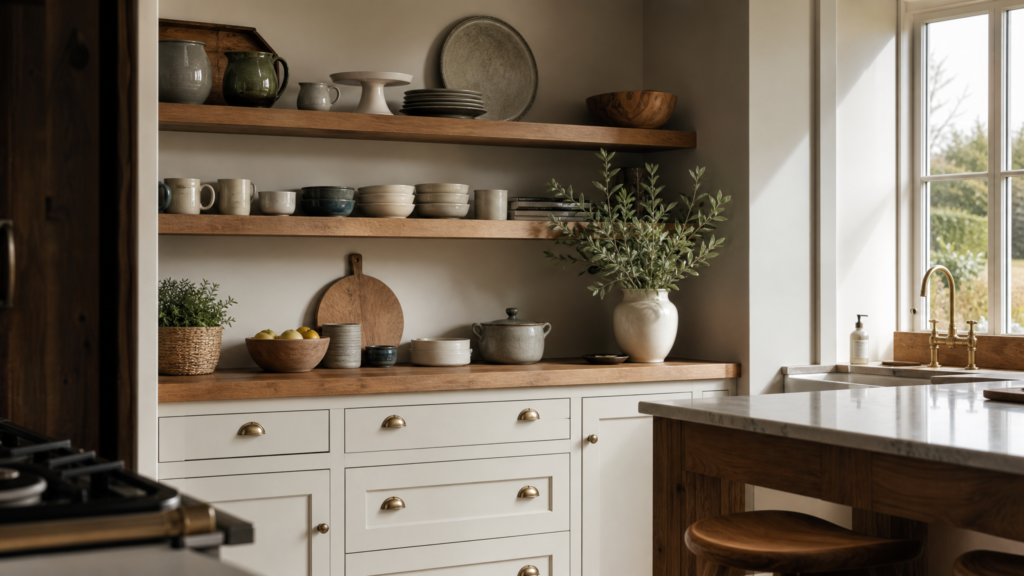
Open shelving splits homeowners right down the middle. Half the people who walk into our workshop have a photo of a beautifully styled kitchen with floating oak shelves loaded with ceramics and olive oil bottles. The other half have lived with open shelving for three years and want it ripped out. Both reactions make complete sense, and here is the honest answer to which camp you are likely to end up in.
Why Open Shelving Looks So Good in Photos
Let us be straight: open shelving genuinely looks wonderful when it is done properly. A run of solid oak floating shelves against a painted wall, holding a curated set of matching crockery and a few well-placed plants, is one of the most attractive things you can do with kitchen wall space. It opens the room up visually, adds warmth, and breaks up what can otherwise be a flat run of cabinet doors. In smaller kitchens especially, removing wall units and replacing them with shelving can make the space feel considerably larger and more considered.
That visual appeal is real. It is not a trick of styling or clever photography. The issue is not with how open shelving looks on day one. The issue is with how it looks on day 365.
The Reality of Living with Open Shelves
Kitchens generate grease, steam, and dust every single day. Closed cabinet doors deal with all three silently. Open shelves do not. Within a few weeks of cooking, every item on those shelves will have a faint film on it. The bowls you thought would look so good stacked neatly are now gathering a slightly tacky residue. The cookbooks have developed a faint sheen. The ceramic pot you put there for decoration has collected enough dust to write in.
This is not catastrophic if you are committed to regular cleaning. But you need to be honest with yourself about whether you are that person. If you wipe down your kitchen surfaces every evening and your idea of relaxing is reorganising the crockery cupboard, open shelving might suit you perfectly. If you are a normal, busy household, the maintenance requirement is genuinely higher than most people anticipate before committing.
There is also the styling commitment to consider. Open shelving only looks good when everything on it is intentional. It punishes clutter severely. Those bread bags, the random stack of takeaway menus, the bottle of washing-up liquid sitting there because there was nowhere else to put it, all of that is now fully visible. What looked curated in the showroom requires real effort to maintain in daily life.
When Open Shelving Actually Works
Here is the thing: open shelving does genuinely work well in the right context. These are the situations where we would confidently recommend it.
As an accent, not a replacement. A section of open shelving flanking a range cooker, or a single run above a breakfast bar, works brilliantly. It adds visual interest without demanding that your entire kitchen be styled to perfection. You keep the closed storage where you need it and use the open shelving to display what you are proud of.
In a utility room or larder. An open larder with solid timber shelving, holding labelled glass jars of dry goods and your everyday crockery, is genuinely beautiful and practical. It is a dedicated space used for storage, so the styling is inherent to the function. It also gets less cooking grease than the main kitchen.
When the shelving is made properly. A shelf that has been made from solid timber, with correctly sized brackets or properly engineered floating fixings, looks and behaves entirely differently from a flat-pack equivalent. The thickness, the finish, the weight of it, all of these things make a difference to whether it reads as a considered design feature or an afterthought. If you are going to do open shelving, it is worth having it made properly.
In the right kitchen style. Open shelving suits certain kitchen types more than others. A shaker kitchen with open oak shelving, a more rustic farmhouse kitchen with chunky timber shelves, or a minimal contemporary kitchen where the shelves are the only visual element all tend to work well. It can feel awkward in a heavily fitted kitchen where there is already a lot going on.
When to Think Twice
If any of the following applies to your household, we would gently suggest reconsidering full open shelving as a primary storage solution.
You cook frequently, particularly frying or using a gas hob. Grease migration is much more significant in these kitchens and everything on open shelves will need wiping down far more often than you might expect.
You have young children. The combination of accessible crockery at child height and the visual chaos of day-to-day family life tends not to work well with the open shelving aesthetic.
You are working with limited storage. If your kitchen is already short on cupboard space, replacing closed cabinets with open shelving reduces your effective storage because not everything is suitable for display. You end up with less room overall, not more.
You want a low-maintenance kitchen. Closed cabinets require almost no maintenance beyond the occasional wipe of the door fronts. Open shelving requires regular cleaning, regular reorganising, and a degree of conscious effort to keep looking good.
The Hybrid Approach Worth Considering
The honest answer for most kitchens is that a hybrid approach gives you the best of both. Closed base units for the practical, everyday storage. Closed wall units in the main run for crockery, glasses, and food. And then one or two runs of open shelving in a specific location, used to display what you genuinely want to see every day.
Done this way, the open shelving reads as a feature rather than a substitute for proper storage. It draws the eye in the right place. It lets you show off the things you are actually proud of. And it does not leave you with a cleaning problem in every corner of the kitchen.
When we are designing a kitchen for a client who wants open shelving, this is usually the conversation we have. Where specifically do you want open shelves? What will actually live on them? How does that work with everything else you need to store? Nine times out of ten, the answer that comes out of that conversation is a hybrid, and the client is consistently happier for it.
What This Means for Your Kitchen Design
Open shelving is not a bad idea. It is a good idea in the right place, made from the right materials, in the right kitchen, for the right household. The mistake is treating it as a straightforward swap for wall units without thinking through the daily reality of living with it.
The best bespoke kitchens we fit tend to use open shelving deliberately, as one element of a wider design that also includes properly considered closed storage. If you are thinking about it for your own kitchen, the question to ask is not simply whether it looks good, but whether it fits the way you actually live.
If you would like to talk through your kitchen design with someone who will give you a straight answer, give us a call on +447749 932 689 or find us on Facebook. We are based in the West Midlands and work across the Midlands region.